Psyonga: Improving Psychosocial Family Well-Being in Psycho-Oncology Through Gamification and Co-Design
2025
https://www.uniklinik-freiburg.de/cccf/cccf-angebote/tigerherz/familienworkshop.html
Dr. Stefanie Pietsch
Dr. Martina Breuning
Loretta Roth
Hannah Strobel
The »PsyOnGa« research and transfer project (funded by BMFTR), led by Dr. Stefanie Pietsch from Tigerherz at Medical Center University of Freiburg, brought together researchers, designers, and cancer-affected families as co-designers. This transdisciplinary, participatory approach translated scientific findings on family resilience — from a rapid scoping review and an interview study — into a concrete, evidence-based support tool to help families cope with the challenges of parental cancer. Throughout the process, social science, psycho-oncology, and design were closely working together.

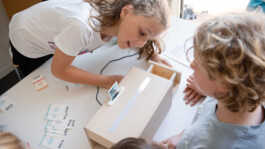
In October 2025 a co-creation workshop took place at the PEAC Museum in Freiburg. Families with children aged 5–16, in which one parent had been diagnosed with cancer, co-created initial concepts for a tool to strengthen family resilience, transforming their ideas into hands-on prototypes. Guided by questions about how such a tool could support everyday family life, participants explored ideas through »physical thinking« – building and making rather than talking alone.


This approach enabled even younger children to contribute without having to explicitly express their needs. A key insight from the workshops was that communication within the family is central to resilience: families are strongest when they stay connected, listen to one another, support each other, and share meaningful moments together. This insight served as the foundation for the further development of the support tools.


In February 2026, families, researchers, psycho-oncologists, and designers met again at the PEAC Museum in Freiburg to further develop the ideas generated during the co-creation workshop in October. The focus was on two hands-on prototypes developed by our lab: »The Pointer« and »The Communication Box«. Participating families brought the objects to life by exploring how they felt and worked in everyday family situations. Through collaborative brainstorming sessions, they identified new areas of application and further developed the prototypes’ functionalities directly on the objects, using the paper-covered tables as a shared whiteboard for notes and ideas.


In addition, all family members completed a questionnaire, providing further insights into their experiences and needs. Families were also able to suggest and implement additional functions and modifications directly on the prototypes. The workshop concluded with a joint vote on which of the two concepts should be developed further. The communication box was selected unanimously and became the basis for the final phase of development.


On May 2026, the PsyOnGa project's closing event took place again at the PEAC Museum in Freiburg, bringing together around 60 participating families and professionals. After 18 months of intensive collaboration between psycho-oncologists from University Medical Center Freiburg, designers from TH Augsburg, and affected families, the project's results were presented and made tangible: a scientific literature review, an interview study, and several practical tools for strengthening family resilience. We presented the communication box accompanied by a traveling exhibition documenting the workshops, insights into the scientific scoping review, and take-home materials such as a family resilience brochure and a family resilience calendar.

The Communication Box is an everyday family object designed to support connection, communication, and shared experiences. It enables families to record and exchange voice messages, preserving not only words but also tone, emotion, and a sense of closeness.

The device is designed to be simple and intuitive to use: via a drawer that opens both to the right and to the left, users can record and play back messages. Visual feedback helps users understand the device’s current status. Physical communication cards make messages, reminders and experiences tangible: they are inserted into the box and act as the key to the stored audio recordings.

The current version includes four card types: message cards for personal notes, greetings, wishes, and everyday information; memory cards for capturing special moments and experiences; calendar cards for messages linked to specific days or future occasions; and number cards for step-by-step content such as instructions, recipes, or games. Additional card types and functions can be added in the future.


The PsyOnGa project showed that prototypes are powerful tools for creating shared understanding. By making ideas tangible, families, researchers, and designers were able to explore, test, and shape solutions together.
The process highlighted how objects can support communication by creating a shared point of reference for personal experiences and sensitive topics. Co-creation enabled ideas and needs to emerge collaboratively, while simple interactions and accessible designs helped connect the results to everyday family life.
The communication box represents more than a final product. It carries the experiences, conversations, and insights that emerged throughout the whole project. From making together to understanding together: through dialogue, experimentation, and moments when words alone are not enough.

Photos: Marc Doradzillo & Jennifer Rohrbacher